
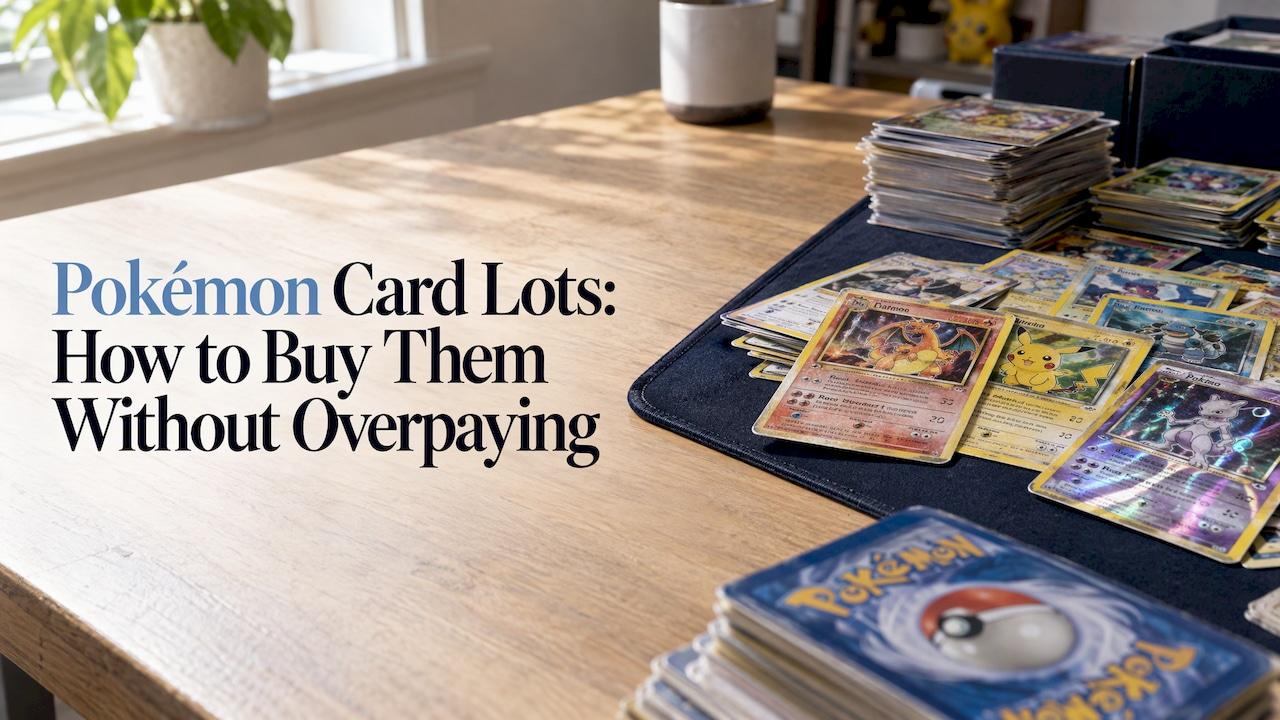
A Pokémon card lot is a group of cards sold together at one price instead of listed one by one. A good lot gives you a low cost per card. A bad one gives you a pile of commons, a few fakes and a photo that showed only the best cards. The difference comes down to four checks: what is actually inside, what the cards sell for individually, whether they are real, and whether the price beats recent sold prices.
This guide walks through each check, with worked examples you can run on any eBay listing.
TL;DR
- A lot is priced for quantity, not for individual cards. Most of the value sits in the few rares, holos or chase cards inside, so look at those first.
- Lot prices vary widely by size and type. Bulk commons are cheap per card, while themed or sorted lots cost more because someone did the sorting.
- Warning signs: stock photos, mystery or repack wording, no holo or rare count, refusal to send extra photos, and a price that looks too good to be true.
- Compare the asking price with recent sold listings for the same cards, then subtract shipping and fees.
- We scan eBay for you and score deals against market data. See the verified raw card deals once you know what you want.
Table of Contents
- What a Pokémon card lot actually is
- What card lots cost
- How to read a lot listing
- Spotting scams and counterfeits in lots
- How to tell if a lot is a bargain
- Lots for a specific Pokémon or set
- Our perspective
- Where Dealmetrik fits in
- Buying checklist
- FAQ
- Sources
What a Pokémon card lot actually is
The word "lot" covers very different products. Three types cover most listings.
Bulk lots. Loose, unsorted cards, usually commons and uncommons, sold by count or by weight. One seller's 1,000-count lot, for example, is weighed out to an estimated 1,000 cards. It holds commons, uncommons and non-foil rares from many sets, with reverse and holo foils added at random, and the seller does not guarantee the ratio or quality of the cards. That is typical: you are buying quantity.
Curated or sorted lots. A seller has pulled the cards by set, era, type or Pokémon. A 500-card lot might list a count of regular holos and rares, reverse holos, commons, uncommons and trainers, and state the condition range (say, near mint to lightly played). More detail in the listing means fewer surprises.
Themed lots. Cards of one Pokémon, one set, one era (vintage, for instance) or one rarity. These cost more per card, because you are paying for the filtering. If you want every Eevee evolution or a stack of one Japanese set, this is the category to search.
Lots can also be advertised in a way that confuses newcomers. A "100-card set" in a listing describes a quantity, not necessarily 100 different cards, so duplicates should be part of your plan.

What card lots cost

Prices depend on lot size, content and condition, and they move. Dated marketplace figures from early October 2026 show how much they spread: TCGplayer market prices for lots were $0.36 for up to 50 cards, $4.50 for 51 to 500 cards, $13.69 for 501 to 1,000 cards and $26.56 for more than 1,000. The pattern is the point: a "Pokémon card lot" is not one product, and the cheapest per-card price is almost always the biggest, plainest bulk.
Use this as a rough map of what drives price:
| Lot type | What you are paying for | What pushes the price up |
|---|---|---|
| Mixed bulk commons/uncommons | Quantity | Lower counts, newer sets, reverse holos |
| Sorted bulk (by set or type) | Someone's sorting time | Popular sets, clean sorting |
| Holo or rare lots | Hit-rarity cards | Count of rares, modern chase rarities |
| Era lots (vintage, early sets) | Age and scarcity | Older print runs, better condition |
| Single-Pokémon lots | Filtering | Popularity of the Pokémon |
One principle explains why a cheap lot can still be a fair price or a bad one: the money is in the handful of hit cards. A lot of mostly commons is worth roughly commons rates, and the whole lot gets valued at the lowest tier if nothing has been pulled out. If a lot is sold unsorted, the seller may or may not have removed the best cards first. If it is sorted and photographed, you can price the best cards individually.
How to read a lot listing
Before you do any math, the listing has to tell you enough to do math. Here is what to look for.
Counts and breakdown
A useful listing states the total card count and splits it: commons, uncommons, rares, holos, reverse holos, trainers, energy. If energy cards are included in the count, say so. If a seller is vague about how many holos or rares are in a 100-card lot, assume the ratio is worse than you would like. A rule of thumb for a lot drawn from one standard set is that you should see a meaningful handful of reverse holos and several rares per 100 cards, and a seller who skips that detail is hiding something or does not know.
Photos
The photos should show the actual lot. Stock images tell you nothing. Ask for a picture of the cards spread out or taken from a random part of the stack, because "seeded" lots show only the best cards on top. Request close-ups of any valuable cards the listing promises. A seller who refuses extra photos is giving you information.
Condition wording
"Played" can mean light wear or a card that has been folded. Look for grading terms (near mint, lightly played, moderately played) and for any mention of bends, creases, water exposure or peeling. When you receive cards, inspect them before sleeving them, since a sleeve can hide marks.
Language and set details
Check whether the lot is English or Japanese, and whether the set code, card number and rarity are listed for the cards that carry the value. Identity details matter because the same character can appear in many sets and variants with very different prices.
Spotting scams and counterfeits in lots
Lots are one of the easier places for a bad seller to hide. A few warning signs come up again and again:
- Seeded photos. The top layer is great and the rest is unknown.
- Mystery or repack wording. A listing that sells the thrill of what might be inside is selling a gamble, not a defined lot. Buy listings where you can see what you are getting.
- Too-good pricing. Pokémon's own support team says that if a price seems too good to be true, it probably is.
- Brand-new sellers with little feedback, no returns, or lots of rare cards at rock-bottom prices.
- Counterfeits mixed in with real cards, especially among holos and modern ultra rares.
CNBC reports that counterfeits are a constant issue and are rising, especially in Pokémon submissions, which is why authentication and careful price research matter before you buy.
A quick authenticity routine
You can do these at your desk when the lot arrives:
- Light test. Pokémon's support page notes that counterfeit cards are often easy to see through when held up to a bright light. Real cards block most light. Some better fakes can pass, so treat it as one check, not the only one.
- Feel and flex. Compare a suspicious card with one you know is real: stiffness, gloss and edges.
- Print and font. Use a loupe on the print pattern, and compare fonts, color saturation and card-back shade against a known real card from the same set.
- Graded cards. If a lot includes slabs, confirm the certification number on the grader's own website, and check that the label and card in the listing photos match the data.
If a lot arrives and a sizeable share of the cards fail these checks, use eBay's buyer protection process and keep your photos of the cards and packaging.
How to tell if a lot is a bargain
Asking prices on eBay are opinions. Sold prices are facts. Anchor your math on what comparable items actually sold for in roughly the last 90 days, matching name, set, edition, variant and condition. A published method for scoring lots against eBay sold comps makes the same point: identity must be matched tightly, and the grade is an unforgiving variable, because raw and graded copies of the same card can differ by an order of magnitude.
Here is a simple routine you can use on any lot.
- List the chase cards. Write down every card in the photos that has real individual value (holos, full arts, ex or V cards, older rares).
- Price each from sold listings. Search the exact card, set and number, filter to sold, and use the typical price, not the highest.
- Value the rest at a bulk rate. Commons, uncommons and non-hit rares go in at a low per-card figure.
- Subtract costs. Shipping, tax if it applies, and your time. If you plan to resell cards, fees as well.
- Apply a margin of safety. Lots carry uncertainty about condition and hidden duplicates. The same scoring approach suggests a margin of around 30% and skipping a lot when you cannot find at least three comparable sold listings or the price spread is far wider than the typical price.
A worked example
Suppose a 300-card lot is listed at a flat price, with clear photos showing eight identifiable holos and the rest commons and uncommons. You find recent sold prices for each holo, add them up, and then add a small per-card amount for the remaining cards. That total is your estimated value. If the asking price plus shipping sits well below it, with room for your safety margin, the lot is worth a closer look. If it only matches your estimate, a few singles bought separately may serve you better. The numbers here are illustrative, so use your own sold-listing research for the actual cards.
Lots for a specific Pokémon or set
If you collect one Pokémon, you have two practical routes. You can buy a themed lot that already filters for it, or you can search for lots from sellers with large inventories and message them. A seller who has several cards of your target Pokémon may be willing to bundle them. Either way, check the set code, card number and language of what you get, because variants of the same Pokémon span many price levels.
For Japanese lots, work in order: identity (name, set code, card number, rarity and language), then structure (bends, creases, dents, water exposure, peeling), then surfaces and edges under angled light.
Our perspective
We built Dealmetrik because the hardest part of buying lots and singles on eBay is not finding listings. There are thousands. The hard part is knowing which ones are priced below what the item is actually worth.
That is the job we automated. We scan eBay for Pokémon and One Piece items, normalize each listing so the product identity, set, version and condition are matched, and compare the price with market data. Our deal score is designed to surface listings that are genuinely discounted, and we apply conservative matching and strict confidence thresholds so that the deals we show are meant to be verified rather than merely cheap-looking.
For a buyer, the practical result is less time reading listings and fewer misleading ones. If you want to buy raw cards, we show you the discount against market data before you click through to eBay. If you prefer sealed product, the same logic applies to booster boxes, bundles and Elite Trainer Boxes.
Lots are a fine way to build a collection, and the checks above are how we think about them too: identity first, then market price, then authenticity.
Joseph
Where Dealmetrik fits in
If you are comparing lots against singles, it helps to see what raw cards are going for right now. We list verified raw card deals from eBay, each scored against market data, so you can price a lot's chase cards quickly.

Prefer sealed product? Browse our booster box deals, booster bundle deals and Elite Trainer Box deals. You can start from the Dealmetrik home page as well. Purchases are completed on eBay through outbound links.
Buying checklist
Keep this next to you when you open a listing:
- Is the total count stated, and is the breakdown (rares, holos, reverse holos, trainers, energy) listed?
- Do the photos show the real lot, including a random section?
- Are the valuable cards photographed close up with set and number visible?
- Is condition described in standard grading terms?
- Is the seller's feedback established, and are returns accepted?
- Does the price beat your own total from sold listings after shipping?
- Does the wording avoid mystery, repack or gamble language?
If the answer to most of these is yes, the lot is probably worth your time.
FAQ
What is a good price for a Pokémon card lot?
It depends on size and contents, which is why the same word covers very different prices. Plain bulk is the cheapest per card, and sorted, themed or holo-heavy lots cost more. Price the chase cards from recent sold listings, value the rest at a low bulk rate, and compare the total with the asking price plus shipping.
Are Pokémon card lots on eBay safe to buy?
Many are fine, but lots are a place where seeded photos, repacks and counterfeits can appear. Pick listings with real photos of the actual cards, a clear breakdown and an established seller, and ask for extra photos before you buy. Pokémon's support page also notes that counterfeits are often easy to see through when held up to a bright light.
Is it better to buy a lot or individual cards?
If you want specific cards, singles are more direct. If you want volume for binders, trading or filling out sets, a lot usually costs less per card. Many collectors do both: a lot for quantity, then singles for the cards they are missing.
How do I check the value of a lot before buying?
Use sold listings from roughly the last 90 days, matching name, set, edition, variant and condition. Add up the chase cards, add a low bulk rate for the rest, then subtract shipping and costs and keep a safety margin.
Sources
- Pokémon Support: Did I purchase fake or counterfeit cards?
- CNBC: Pokémon card values, grading, buying and selling guide
- Scoring Pokémon card lots against eBay sold comps
- Pokémon card lots: dated prices